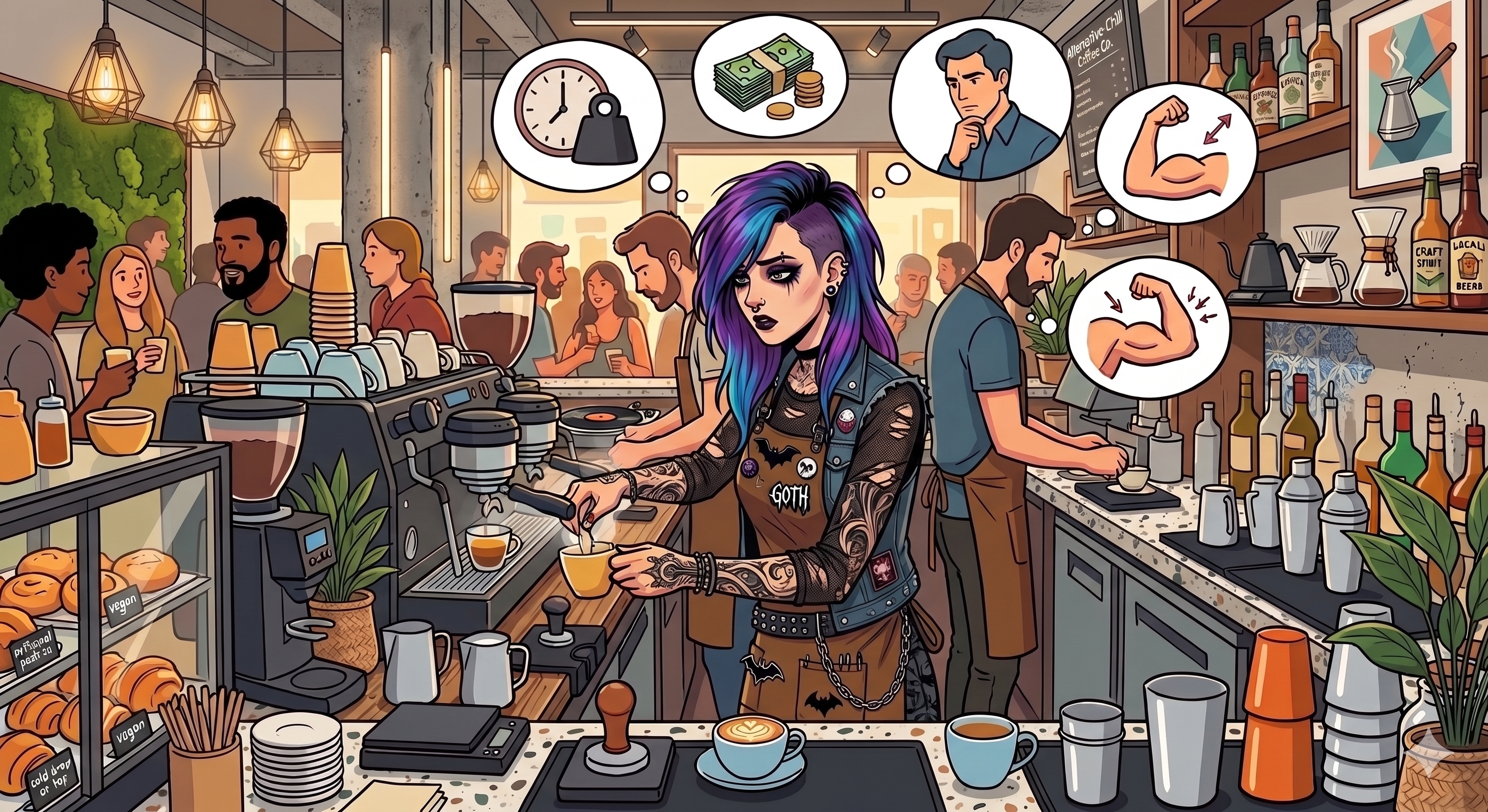
Being a Female Employee in the Fast-Moving Consumer Goods Sector
Introduction
According to unwritten rule of the Fast-Moving Consumer Goods Sector, how rude or capricious the customer is ;the female employee always expected to be the humbling, smiling and accommodating party. Sociologist Arlie Russell Hochschild, in her work The Managed Heart, explains this situation not as a simple rule of courtesy with the concept of emotional labor. According to Hochschild, emotional labor is the management of one’s own facial expressions and feelings for a fee in order to create the right mood and sense of satisfaction in others. In the service sector, there are many different dynamics besides physical labor such as carrying heavy trays or cleaning coffee machines. This “illusion of sincerity” offered to customers has not only become an integral part of the business, also turns people’s emotions into a commercial commodity and exploits them. In the fast moving consumer goods and service sectors (especially bars and coffee shops), women are numerically employed but are systematically excluded from managerial positions. Women should not be managers due to their nature.Also while women in the sector are generally pushed into areas coded as “women’s work” such as cleaning, service and customer hospitality, male employees are quickly moved to managerial positions with the glass escalator effect. Beyond this vertical segregation, female employees are constantly forced to deal with implicit sexism and customer harassment in their daily practices. In the eyes of both customers and managers women can be scolded more easily than men because they lack the status shield that men have.They are made much more vulnerable to exploitation, mansplaining and rude behavior. As a result of these behaviors female employees who experience mental fatigue rather than physical fatigue end up going through a leaky pipeline process after experiencing burnout. Being removed from the industry for nothing leads them into an allination. When this emotional exploitation and structural obstacles that women are exposed to in the fast-moving consumer goods sector are examined from a Marxist-feminist perspective, it is seen that the issue is not just a “workplace challenge”. Marxist feminism draws attention to double oppression by arguing that both capitalism and patriarchy work as an inseparable system at the basis of women’s oppression(Cottais n.d.). According to Marxist feminist theory; the services offered by women in bars and coffee shops such as; smiling faces, softening the atmosphere, listening to customer problems and cleaning, are actually the transfer of “unpaid domestic labor” is obligatory to women in the home to the public sphere and the paid labor market(Guy-Evans 2024). The capitalist system devalues women’s practices such as caring for others, empathizing and providing emotional support as a “natural feminine duty”. If customers vomit the alienation and anger created by the system on the female employe. The woman is expected to absorb this anger and “soften the breath of the environment”. Capitalism turns its own wheels and makes a profit through this invisible labor and emotional repression of women. In the context of all this theoretical framework and deficiencies in the literature the central question of this critical ethnography study is determined as: Women working in the fast-moving consumer goods sectors in Turkey; how does it deal with the masculine work culture produced at the intersection of capitalism and patriarchy, the practices of “implicit sexism” and the exploitation of “emotional labor” expected of them?
Methods & Sampling
Critical Ethnography was used for this study. Because the purpose is not just to depict the situation. To make the voices of women employees heard, to exhibit an advocacy-based approach against patriarchal domination and inequality. A scientific interpretation was made by the researcher with an ethical perspective taking the emic perspective of the participants to the forefront. The area of the research consists of 4 coffee shops and 1 bar environment selected for the purpose in order to see the different dynamics in the sector. Although these different spaces were chosen in accordance with the nature of the ethnographic research. They were all considered as a single culture sharing group that jointly produces masculine working practices emotional labor processes and beliefs in the fast moving consumer goods sector. Most information rich about the purpose of the research female employees with experience in the sector were deliberately selected; purposeful sampling was applied. To reveal all the dimensions and variability of the sector, both a barista working the day shift and a bartender working the night shift. Maximum Variation Sampling was used with the aim of a diversity that would include both students and part-time employees and experienced full-time working women. The data were collected through observations and one-on-one in-depth interviews conducted in the natural working environments of the participants during the extensive fieldwork process in accordance with the ethnographic approach . İnformed consent was obtained from all participants and their confidentiality was guaranteed. As a researcher, I am not a dispassionate reporter myself; I have the experience of working in this sector and I am in a position to speak out against inequality with a political mindset. For this reason, I followed a reflexive writing strategy by reflecting my own sociocultural background and a priori knowledge of the field in the text.
Data Analysis
I continued simultaneously with my data collection while I was in the field; I conducted it according to the Data Analysis spiral model, which asks analytical questions and progresses from general to detail. First of all, the audio recordings of the in-depth interviews conducted with 5 participants (Ayça, Beyza, Dolunay, Elif, Selda) were transcribed and the field observation notes were cleared. I read all the data from beginning to end in order to get a general idea and during these readings, I made my first connection with the data by memoizing the margins of the pages. Considering the density of qualitative data; I used MAXQDA to organize texts in a hierarchical system, analyze them line by line and question the relationships between concepts. The coding process was carried out in two stages, inspired by the Grounded Theory analysis steps; Open and Axial Coding were used. As a result of the open and axial coding, 4 main (axial) themes reflecting the experiences of women working in the fast-moving consumer goods sector and the sub-(open) codes related to them were determined as follows:
- Gender Based Division of Labor and Hierarchy (Horizontal and Vertical Segregation) Horizontal Segregation: Practices of assigning technical jobs to men in institutions and drudgery cleaning and service jobs to women on the grounds that “women’s hands are more inclined”. Vertical Segregation: Experienced female employees who carry the entire workload of the space are not promoted, but less experienced male employees are promoted to managerial or supervisory positions much more quickly.
- Emotional Labor Management and Alienation Surface Acting: Female employees wear a fake smile to conform to the sexist expectations of the space, even when they are tired or angry. Deep Acting: Rejection and Burnout: Participants consciously refuse to empathize with unfair customers, but the expected emotional labor load leads to serious “mental drain” and allianation at the end of the working day.
- Masculine Authority, Harassment, and Lack of Status Shield Status Shield: Shortcoming: While customers are shy towards male employees with the delusion of masculine authority, they are comfortable raising their voices towards female employees, behaving rudely and seeing them as an object that can be scolded. Implicit Sexism and Mansplaining: The practices of both managers and male colleagues to teach the job from above by bossing even the female employee who is an expert. Management’s Lack of Protection: In cases of harassment or customer aggression, the venue management pacifies the female employee instead of standing behind her.
- Feminist Standpoint and Solidarity Collective Emotional Labor: The survival mechanism that female employees build to protect each other against harassment, oppression, and mansplaining practices in the workplace and to heal each other emotionally by coming together. The findings of this study are presented to the reader using thick description in accordance with the nature of Critical Ethnography. Along with the conceptual relationships established with similar research in the literature, the experiences of the participants will be represented by the scientific interpretation of the researcher through short and long block quotations consisting of their own statements.
Theoritical Framework:
FMCG sector; It is a very challenging industry dominated by low wages, poor job security, long working hours and flexible working hours, which puts a high pressure on the employee. Although this sector seems to be an area where women’s employment is intense in the social field, it has a paradoxical structure in which traditional masculine values and male-dominated culture are dominant in management levels and organizational hierarchy(Oruc 2014). Within this masculine sector, female employees are positioned not just as a physical workforce but as an extension of gender roles. Women are often pushed into low-status jobs such as cleaning, service and customer hospitality, which are considered “prone to women’s nature and hands” and are exposed to horizontal segregation. On the other hand, despite bearing the full burden of the business they are excluded from decision making mechanisms and managerial positions and face vertical segregation and glass ceiling obstacles (Coleman 2010). The actual product produced in bars and coffee shops is not just a drink, but also “the feeling and courtesy offered to the customer”. As defined by Arlie Hochschild, this is the process of emotional labor that requires women to manage and sell their own facial expressions and emotions for a fee. According to Barbara Risman’s Gender as a Social Structure model, gender-based inequalities are produced in workplaces at three levels: individual, interactional and institutional. At the corporate level, companies construct the division of labor and hierarchy in a sexist structure. The main task of these corporate places is to mold female employees in workplaces. According to Hochschild, emotional labor in the service sector occurs in two ways, surface acting; in which the worker only changes his appearance, smile or body language, and deep acting, in which the worker forces his inner world to really feel that emotion . The capitalist system leads to the transformation of the emotional system by standardizing this emotional management of private life with company procedures. Moreover, Hochschild states that women have a weaker status shield compared to men. The feelings of women who are seen as inferior in the sector are trivialized. Customers’ frustration, anger, and implicit sexismare directed directly at female employees. Women are expected to absorb this anger and tolerate rude behavior with the logic that “the customer is always right. This expectation of tolerance is not shown towards men, the subject of oppression is usually women. According to Marxist feminism, the basis of this oppression of women lies in the fact that capitalism and patriarchy work as an inseparable and intertwined system. Within this system women are subjected to dual exploitation, not only as a “worker” whose labor is exploited by capitalism, but also as a “woman” oppressed by patriarchal institutions (Cottais n.d.). Marxist feminist theory explains how the capitalist system devalues women’s labor with the concept of social reproduction(Guy-Evans 2024). According to this, smiling face expected from female employees in bars and coffee shops, listening to the customer’s whims, softening the atmosphere, cleaning and serving practices are public sphere of domestic care labor. Which is imposed on women free of charge at home. The capitalist system needs employees to be emotionally served for the production process to continue without interruption. There are economically devalued because the system codes this emotional labor offered by women as a duty of women not as a professional skill. Capitalism transforms not only physical labor; also the most intimate feelings, smile and empathy of human beings. Hochschild states, into a commercial commodity. The infiltration of the profit making motive between human relations causes female employees to disconnect from their own bodies and feelings, intense alienation. This emotional exertion exhibited by the woman, whose boundaries are violated and asked to tolerate harassment in exchange for a fee, tears the individual away from her true self at the end of the shift. This deep emotional exhaustion and exploitation created by capitalism goes beyond ordinary work fatigue and turns into a chronic class hatred, structural alienation against the masculine system and working life. Feminist Standpoint Theory emphasizes that marginalized women are not mere victims. Just being a woman does not automatically give a person a feminist stance. This standpoint entails an intellectual and political struggle to recognize, analyze, and oppose the power relations that create the subordinate position of women(Wood 2009, 397). Women working in the fast moving consumer goods sector see the social reality more clearly than the dominant groups. Surviving as a members of the oppressed group, they have to understand both their own reality and how the sovereign works. Women in the sector the solidarity networks that managers develop among themselves against “mansplaining” practices or customer harassment are a reflection of a strong critical stance and survival mechanism built against this corporate domination.
Findings and Discussion:
When you step through the door of a coffee shop or bar that seems modern, dynamic and gender-neutral from the outside. You encounter an invisible caste system operating in the background. The research findings strikingly reveal that women are confined to certain tasks such as cleanliness, order and customer reception just “because they are women” .They are exposed to a systematic horizontal segregation. S., one of the participants who experienced this situation in the field in the most striking way, conveys how institutions carry out manipulative employment policies just because of this sexist pre-assumption with the following words: “Yes, this horizontal divergence is so sharp I can give a very extreme example of this. Because of with this sexist division of labor, I worked in a business that employs only female employees! The management of the place made guarantee that the shop was cleaned properly every day and the code in their minds was, ‘A male employee cannot clean, he is incapable of cleaning and he does not want to take up this heavy cleaning job.’ They officially gave the dirty work of cleaning to the woman, because they thought that men would not clean so in the big place they only took female workers. A machine breaks down in the shop, a technical problem arises; Although there was no distribution of duties, the male employee would jump on that technical job by saying ‘I can do it’.” This burden of “drudgery” described by S turns into a complete “double exploitation” in the morning opening practices at the coffee shop where E. works. E.describes how the burden of preparing the showcase of the space is unfairly distributed between the sexes as follows: “At the opening of the place only female employees were appointed to do cleaning work. We had to sweep the floors, dust, look at the toilets. Also, the male employee came to work later, at 09.00, although the place opened at 08.00. When he came he would not clean at all. He would supposedly do ‘physical/technical’ work like lifting heavy parcels. But this was the unfair and hypocritical part of it: While he was doing the hard work we women were to help him out. In other words, there was no full and fair division of labor; the woman was both doing the cleaning, which was considered her domestic obligation, and rushing to help the man’s “heavy work.” Women’s efforts in this spiral of intense exploitation and horizontal segregation are not enough to move them up the corporate hierarchy. While women are overwhelmed by this intense physical and emotional labor, male employees, who are a minority in number, are quickly promoted to decision making supervisory or managerial positions with an invisible glass escalator. The implicit sexist belief that men have a “natural authority” in the sector and therefore will manage the space better prevents women’s vertical segregation. E. personally witnessed how men were rewarded with glass elevators while women hit invisible glass ceilings: “My girlfriend started working at the place I was at before me and from morning to night she took the entire weekly amount from the place and did it alone for months. That girl was a waitress, she made drinks, cleaned, cared for the kitchen… A guy came into the place around the same time as him. He later went behind the bar… Meanwhile my girlfriend stayed in the same downtrodden state while she was still doing the entire place, that boy went and became manager/head chef out of crazy. The girl did the entire work, anyone looking outside can see how much she did and all of that work was nothing to the boss who found that boy more qualified for ‘management and scientific labor’ that glass elevator moved the boy upstairs instantly and continued to exploit her.” Analyzing the patriarchal mechanism underlying this vertical inequality, S. summarizes how the need for masculine authority in the sector devalues women’s labor with the following striking finding: “Another gender discrimination occurs in consciousness of this sector, such as ‘The staff are not capable enough to convince the customers and employee, and manipulate them by their pressure; but women are not capable to create such sort of authority due to their nature’. As a consequence, men are promoted more quickly… I had seen that because I am a woman; my workmate that has no as much as working experience or does not know the job as well as me has rapidly obtained a step on top of my shoulder just because of being a man.” These findings clearly shows being a woman in bars and coffee shops is not just fulfilling a specific job description; it also means polishing male authority, taking on heavy care labor for free, and accepting being systematically made invisible in promotion processes.
Conclusion:
This critical ethnography study revealed how women working in fast-moving consumer goods sectors are exposed to double exploitation at the intersection of capitalist and patriarchal systems. Findings shows that although the sector seems to be open to women’s employment, horizontal and vertical gender segregation operates sharply in the background. It also shows that women are deprived of status shields and forced into hard emotional labor and alienation. However, the primary goal of critical ethnography is not merely to depict the inequality that exists but to offer a vision of advocacy that empowers marginalized groups and sparks change. The collective survival practices developed by the participants in their workplaces. It proves that women are not passive victims, but rather active subjects who force change. The following solutions are offered to eliminate structural inequalities in the service sector and build a fairer working environment:
- Corporate Policies and Status Shield: Instead of removing women from the night shift and replacing them with men in order to “protect” them. Businesses should develop “zero tolerance” policies that stand behind female employees when customers cross borders. As Hochschild emphasizes, the understanding of “the customer is always right” and the “illusion of service” should not pave the way for emotional exploitation and verbal abuse of women.
- Physical Safety and Logistics: Women’s nighttime transportation safety should not be used as a “disadvantage” or an excuse for dismissal based on implicit sexism. Safe transportation ,taxi, should be provided by the employer as an absolute standard.
- Making Emotional Labor Visible and Fair Division of Labor: Horizontal segregation should be prevented in workplaces. Technical, management and cleaning work should be distributed equally without gender-based preconceptions.
- Equality Plans and Transparent Promotion Processes: Objective and transparent promotion criteria should be determined to break the glass escalator effect. As suggested in the literature Equality Plans practices that support women’s access to management levels. Also its include flexible working and mentoring networks should be encouraged and supervised, regardless of the scale of businesses.
References:
• Coleman, I. (2010). The global glass ceiling: Why empowering women is good for business. Foreign Affairs, 89(3), 13-20. • Coşkun, Ç. (2014). [Review of the book Türkiye’de Kadın Özgürlüğü ve Feminizm (1908-1935), by Z. Toprak]. Osmanlı Araştırmaları / The Journal of Ottoman Studies. • Cottais, C. (n.d.). Marxist and socialist feminism. (M. Fourey, Trans.). • Gender.Study. (2025). Postcolonial feminism: Analyzing gender and cultural imperialism. • Guy-Evans, O. (2024). Marxist feminism theory. Simply Psychology. • Hochschild, A. R. (2003). The managed heart: Commercialization of human feeling (20th anniversary ed.). University of California Press. • Le Roux, K. (2019). Generational differences in the work values and behaviours of employees within the fast-moving consumer goods (FMCG) industry [Master’s thesis, Gordon Institute of Business Science, University of Pretoria]. • Oruc, I. (2014). Women’s work - men’s work: A Turkish ethnographic study. African Journal of Hospitality, Tourism and Leisure, 3(1). • Segovia-Pérez, M., Figueroa-Domecq, C., Fuentes-Moraleda, L., & Muñoz-Mazón, A. (2019). Incorporating a gender approach in the hospitality industry: Female executives’ perceptions. International Journal of Hospitality Management, 76, 184–193. • Tekeli, S. (2010). The Turkish women’s movement: A brief history of success. Quaderns de la Mediterrània, 14, 119-123. • UNICEF. (2017). Gender equality: Glossary of terms and concepts. • Wood, J. T. (2009). Feminist standpoint theory. In S. W. Littlejohn & K. A. Foss (Eds.), Encyclopedia of Communication Theory (pp. 397-399). SAGE Publications
// Yorumlar
Yükleniyor...