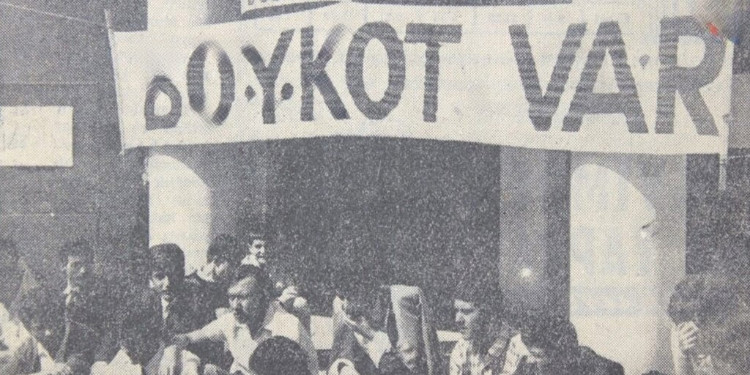
Student Mobilization in Universities
Introduction
On the morning of March 19, students on the Başkent University campus raised a honorable flag of rebellion not only against the school’s overpriced prices and unfair disciplinary penalties, but also against the neoliberal domination of foundation universities, which see them as mere “customers” and consumers(Giroux 2014. This mobilization, sparked by a WhatsApp message, brought students who had been imprisoned in an apolitical bubble for years shoulder to shoulder. As one student from the heart of the action exclaimed, this process was the first time that students embraced the fact that they could “seek their rights in the public sphere”. As Alberto Melucci emphasizes for contemporary social movements, the real success is not the immediate change of the system or the achievement of a concrete gain; it is the weaving of those strong “we” feelings and solidarity networks that challenge individualism, created by the action itself (Melucci 1996). Regardless of the final result, this collective consciousness created by us as Başkent students who stand shoulder to shoulder against injustice is the greatest victory against the atomizing structure of the neoliberal university. Current literature examining the awakening often focuses on well-established public universities whose leftist tradition and culture of action are already strong(Gencoglu and Yarkin 2019). Moreover, it compresses the class and capital dimension of the issue into a narrow framework. One of the of struggle is the dynamics of resistance in foundation universities, where students are exploited with high fees and tried to be tamed by imprisoning them in the identity of “customers”, are persistently ignored in the literature. In this research, it was determined by the findings that even against the nationalist attacks, the “apolitical” student of Başkent University was able to take a stance. How they established the strong solidarity pointed out by Melucci is a huge gap in the literature that needs to be filled (Melucci 1996). This study is an example of a Critical Case Study and the purpose of this study, including my own experiences; The mobilization at Başkent University, which was ignited by the March 19 boycott, is to reveal the creative organizing practices developed by the students against institutional pressures and the internal and external obstacles that led to the withering away of the movement.
Research Questions:
Central Question: How did Başkent University students experience mobilization and organization practices during the March 19 process? Subquestions:
- Through which digital communication channels (social media, WhatsApp, etc.) did students initially come together and how did they establish solidarity networks?
- How did the institutional constraints and on-campus security pressures of being a foundation university limit students’ activism and organizing practices?
- What kind of hierarchical or ideological tensions have been experienced between different student groups such as “Initiative” and “Representatives” during the process?
- How did the movement’s lack of theoretical background and the students’ previous political inexperience affect the course of the activism process?
- What are the main factors that led to the demobilization of the movement during and after the May 1 process?
- Although the boycott process has faded, what impact did the emotional outputs (collective consciousness, anger, pride) experienced by the participants have on the future potential (latency) of the movement?
Methodology:
This study, in which I am in the field, aims to understand the resistance of students to neoliberal university policies and institutional pressures. Methodologically, it is a qualitative Qualitative Case Study based on the Critical Theory paradigm. Critical paradigms center on questioning power relations, domination and inequalities. I would like to state that I have personally created a field of advocacy in which I speak out against inequality with a political mindset rather than being value-free. This study is structured as a value-laden. The fact that I was doing research on the process I was involved in gave this study an auto-ethnographic and critical dimension. For this reason, the principle of reflexivity has been adhered to. The bounded real-life context in which the event took place is bounded system, which constitutes the case study design of the study. Probability-based Purposeful Sampling strategy was used in the research. It is aimed to reach the participants who will best reflect the phenomenon. In accordance with the ontological assumption of qualitative research, the principle of multiple realities has been adopted. In order to reflect this multiple reality with multiple perspectives and all dimensions of the problem, the sample selection was made by considering Maximum Diversity. The interviewees were carefully selected both from within the ‘Initiative’ or ‘Representatives’ groups that manage the organization in the “kitchen” of the movement, and from among the unorganized students who participated in the process from outside Face-to-face and semi-structured in-depth interviews were used as the main data collection method of the research, and a developing design was adopted. Interview questions were kept flexible; According to the position of the interviewee in the action, whether he is organized/unorganized and his perspective on the event, the questions were shaped and deepened face-to-face during the interview. In this way, the focus was on the participants’ own meanings attributed to the process rather than the meanings predetermined by the researcher. The data obtained from the interviews were analyzed with the combination of deductive and inductive logic. MAXQDA was used to organize dense text data, place it in a thematic hierarchy and create concept maps. In accordance with the data analysis spiral, the texts were read, memoing was applied and the coding process was started. A deductive open coding was made through the concepts of Melucci and Tarrow, which formed the theoretical framework of the research. The texts were divided into meaningful small units and labeled, and then these subcodes (e.g., WhatsApp communication issues or corporate pressures) were created with axial coding. These sub-themes are related to each other and transformed into main themes around the fading and emotional outputs of the movement. This insider position has given me in-depth access and a wealth of knowledge about events. I have practiced continuous reflexivity throughout data analysis to avoid manipulation during interviews and to objectively reflect the experiences of different groups (e.g., Initiative System supporters or apolitical students) with emic perspective.
Theoretical Framework:
While traditional theories of social movements often focus on class interests and the goal of seizing political power, contemporary movements go beyond this understanding. As Melucci states, contemporary movements aim not only to achieve a concrete political or economic goal, but also to create a network of “we” and solidarity through the action itself. In the process of politicization of daily life, cultural codes and individual experiences, the real success of the movement is the sense of solidarity built around a common goal. Activism processes are not always limited to visibility (being on the street). According to theorists such as Melucci and Sidney Tarrow, the fading phases of movements after the active action phases do not mean an “extinction”(Melucci 1996; Tarrow 2011). On the contrary, this period is when the movement is out of visibility; These are the periods when daily relationships, friendships and informal networks go into a secret waiting and solidarity phase(Melucci 1996). The boycott process at Başkent University did not completely disappear after the end of active action, but evolved into this secret phase through the new solidarity networks established by the students. However, the power of these networks comes from the fact that students with similar socio-cultural structures find each other. Because they are in the middle-upper majority of the student body and structurally far from politicization, this solidarity practice has inevitably made this practice of solidarity difficult. In order to make sense of the apolitical past and activism practices of Başkent University students, it is essential to look at the historical and structural transformations that higher education in Turkey has undergone. According to Gencoglu and Yarkin (2019), student movements in Turkey have been put into a radical “depoliticization” process with the YÖK and state policies established after the 1980 coup. Neoliberal policies implemented after 1980 suppressed students’ political activism with strict disciplinary regulations and transformed universities into institutions governed by a free market mentality(Gencoglu and Yarkin 2019; Giroux 2014). Foundation universities are the clearest manifestations of this neoliberal domination and marketization. The apolitics of the structure at Başkent University, which generally consists of middle-upper class students, and the difficulty in displaying a consistent political stance in the past are directly the result of this neoliberal and depoliticizing construction of higher education. One of the main reasons for their difficulty in this political stance can be said to be the inexperience of Generation Z (weak generational memory) in the political arena. Because the effort to be political and create a political memory developed by the previous generation during the Gezi Park process is not seen in Generation Z. Behind this are some disadvantages brought by digitalization (increase in clicktivism over time, transformation of social media into a propaganda tool…) (Mutongoza and Hendricks 2025).Despite this, Generation Z learns to use the advantages of digitalization and advancing technology more quickly than previous generations. The dynamics behind the mobilization of students despite their political inexperience can be explained by Sidney Tarrow’s “The Dynamics of Adversarial Politics” approach. According to Tarrow, social movements; It rises on threats, mobilizing structures and framing trivets. In the context of Başkent University, high price hikes, security pressure and unfair disciplinary penalties imposed by the school administration have created a common window of “threat and opportunity” for students. WhatsApp groups used by students for communication suddenly turned into “mobilizing structures” and the process was positioned as a general “claiming rights” tool. The inability of these initial dynamics to evolve into a coherent political stance in the long term is directly related to Benford and Snow’s (2000) theory of “Framing Processes”. According to the researchers, in order for movements to be successful, they must fulfill three basic framing tasks: diagnostic, prognostic and motivational framing. Başkent University students successfully defined the problem with their anger against price hikes and injustices and were able to establish a “diagnostic” framework. However, the weak theoretical background and political grounds of the students prevented the development of a viable “prognostic” strategy that would direct the masses to a common goal and a “motivational” discourse that would persuade them to continue the action. This deficiency in the construction of meaning has made it difficult for actions to be placed on a sustainable basis. The rapid inflammation of the movement through digital communication channels and then withering away with its own internal conflicts is closely related to the current digital activism literature. Mutongoza and Hendricks (2025) point out that while social media platforms enable information to spread very quickly and reach large audiences, these platforms lack traditional centralized leadership structures. In other words, it leads to incoordination in movements, inconsistent messages and internal divisions. The “irresponsibility, lack of order” and the movement’s entry into hierarchical conflicts by grouping as “Initiative” and “Representatives” are exactly in line with the leadership vacuum created by this digital decentralization (Mutongoza and Hendricks 2025). In addition, the fact that students leave the streets or campus squares quickly, causing the movement to fade away, can be explained by the concept of clicktivism emphasized by Mutongoza and Hendricks. Clicktivism gives individuals the feeling that they are making a meaningful contribution simply by liking, sharing, or commenting on content on social media. The described form of passive participation prevented the transformation of digital support into concrete and transformative physical actions and became one of the main structural problems in the decline of the Başkent student movement by losing momentum.
Data Findings:
The March 19 Başkent University boycott process developed spontaneously, not like the long-term plans of traditional political organizations, but with the accumulated anger of the students. In the early stages of the process, the actions were organized by word of mouth through WhatsApp groups and social media. As the participants testified, students from different faculties have come together around open forums and walks, weaving a dynamic network of solidarity on campus that is alive but “can be extinguished as quickly as a flame of straw”. This first phase was a breaking point when students faced the fact that they could seek their rights in the public sphere for the first time. Although the networks established through WhatsApp groups and social media forums initially promised horizontal hierarchy to the participants; As the process progressed, this structure turned into a serious crisis of representation. The lack of equal effort by the representatives of different faculties within the university and the communication gaps in the process led to the centralization of the “Initiative Group”. This centralization has caused divisions among the participants; for example, Participant K. harshly criticized the situation, arguing that “the democratic functioning was undermined”, “I know” attitudes were exhibited and “acted according to the whim of a small group” with the involvement of the Initiative in the process. On the other hand, Participant İ.A., who played a guiding role within the Initiative, tried to rationalize this centralization by attributing the disappearance of the horizontal hierarchy to the political inexperience and institutional pressures of the masses and saying, “No matter how open it is tried, a more closed organization has been realized for security reasons.” Especially the separation at this point has occurred due to the differentiation of organizational practices. On the one hand, it has an organizational profile, domination of the political field and a habit of hierarchy; on the other hand, there was an unorganized dimension that had not entered the political field before, adopted an apolitical lifestyle. One of the main dilemmas of the movement is that a large part of the participants (especially Generation Z) lack a political/theoretical background and that activism proceeds with populist, momentary emotional reflexes. As the participant İ.A. stated, the mass is there “to vomit their anger against the order” rather than to make a political analysis in general. The sharpest break in the dampening of the movement was experienced during the May 1 process. The participation of the students of the Başkent University the boycott process has lost momentum not only due to the inexperience in student dynamics, but also due to the institutional limitations arising from the fact that Başkent University is a “foundation university”. As participant M.A. stated, the current government’s “intimidation policies” have directly stifled the activism on campus. Participant K., on the other hand, revealed that due to the fact that most of the students were “scholarship students and relatively comfortable moneyed students” and the idealist roots of the school, the mass could not have the solid culture and structure of resistance in universities such as METU. Fears of disciplinary investigations, fascist attacks and increased security measures have led to student participation not on the street; They imprisoned it in a passive social media reaction. In the May 1 cortege without sufficient infrastructure, common slogan and political legitimacy caused the movement to experience a physical and political disorganization. Eventually the unorganized students became alienated from the process and quickly withdrew with the effect of the approaching visas and the exclusionary discourses of the school. According to institutional limitations arising from the Başkent University is a “foundation university”.As participant M.A. stated, the current government’s “intimidation policies” have directly stifled the activism on campus. Participant K., on the other hand, revealed that due to the fact that most of the students were “scholarship students and relatively comfortable moneyed students” and the idealist roots of the school, the mass could not have the solid culture and structure of resistance in universities such as METU. Fears of disciplinary investigations, fascist attacks and increased security measures have led to student participation not on the street; He imprisoned it in a passive social media reaction. Although the movement may seem to have failed or completely faded from the outside, the data directly confirm Alberto Melucci’s theory of “new social movements”. As Melucci states, activism does not disappear when it loses its visibility; it only changes form and passes into a phase hidden in the network of relations. In the case of Başkent University, although some students felt “anger and resentment” due to the systemlessness and irresponsibility created by the conflict between the Initiative and the Representatives, the biggest gain of the process was the collective consciousness and pride achieved. Participant M.A. stated that thanks to this process, the students “became aware of their individual rights” and gained awareness of social movement. Participant K.A. stated that he “gained practical knowledge” thanks to the actions; Participant K. summarized the emotional and political legacy left by the movement with the following words: “The lack of system… Of course, I carry a sense of uneasiness and unhappiness that it causes, but I think the feeling of being part of a whole is priceless, and I am proud that we have been able to provide such a movement in the Başkent.” These data prove that the Başkent students movement did not actually fail, but turned students into democratic subjects, leaving a strong emotional infrastructure for possible future mobilizations (Melucci 1996).
- Conclusions This critical case study examines the implementation of depoliticization policies after 1980 and the student resistance at the foundation university, which is the epitome of neoliberal education. The findings obtained from the field data shed light on the transformation of students from an apolitical mass to “democratic subjects” and how social movements facilitate change at the micro level, rather than structural problems. Student movements are often evaluated in terms of concrete gains, such as the withdrawal of price hikes, or major changes targeting political power. However, as Alberto Melucci emphasizes in his theory of contemporary social movements, the action itself and the model of organization are the real message given to the rest of society. In the case of the Başkent, the political inexperience of the students or the inability of the protests to spill over the campus in a short time is not a failure; On the contrary, the real success is that individual people show the ability to say “we” in the face of a common injustice. The research findings clearly reveal that the biggest gain of the process is the “collective consciousness, belonging and pride” created in the participants. The fact that individuals state that “the feeling of being part of a whole is invaluable” shows that the movement repairs fragmented social relations and successfully weaves the strong solidarity network expressed by Melucci. The study answers the question of how civil society facilitates change in different societies through a micro-campus ecosystem with the following key lessons:
- Contrary to popular belief, foundation universities are not only places where apolitical masses or consumer subjects exist. When institutional pressures create a window of threat, spaces can transform into vibrant spaces of democratization where students become aware of their individual rights and develop civic initiatives.
- Civil society facilitates change not only by changing macro laws, but also by changing the way individuals make sense of their own lives and injustices. The fact that students from different faculties and backgrounds come together through horizontal networks such as WhatsApp and experience the culture of open discussion in forums is the most concrete example of how civil society spreads its democratic communication skills to the grassroots.
- The power of civil society to create change is longer than the life of the action. Although the movement’s presence on the street/campus was short-lived, the awareness of seeking rights gained by the participants permanently increased the democratic capacity of the society for the next social mobilizations. Civil society feeds macro-level democratization from the grassroots by making people feel that they are “a valuable part of a social whole” even in the slightest moment of resistance.
References:
• Benford, R. D., & Snow, D. A. (2000). Framing Processes and Social Movements: An Overview and Assessment. Annual Review of Sociology, 26, 611-639. • Creswell, J. W. Qualitative Research Methods: Five Qualitative Approaches. • Ellis, C. (2020). Revision: Autoethnographic Reflections on Life and Work (Classic Edition). Routledge. • Gencoglu, F., & Yarkin, D. B. (2019). The student movement in Turkey: a case study of the relationship between (re)politicization and democratization. Journal of Youth Studies, 22(5), 658-677. • Giroux, H. A. (2007). The University in Chains: Confronting the Military-Industrial-Academic Complex. New York: Paradigm. • Giroux, H. A. (2014). Neoliberalism’s War on Higher Education. Chicago: Haymarket. • Melucci, A. (1996). Challenging Codes: Collective Action in the Information Age. Cambridge: Cambridge University Press.w • Mutongoza, B. H., & Hendricks, E. A. (2025). Social Media and Student Protest Mobilisation in South African Universities. Research in Social Sciences and Technology (RESSAT), 10(2), 205-219. • Tarrow, S. G. (2011). Power in Movement: Social Movements and Contentious Politics (Revised and Updated 3rd Edition). New York: Cambridge University Press.
// Yorumlar
Yükleniyor...